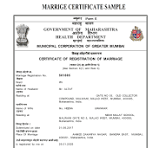
2. Marriage Details:
- Date of Marriage: The exact day, month, and year the marriage took place.
- Place of Marriage: The location, which could include the name of the venue (e.g., church, courthouse) and the city or town where the ceremony occurred.
- Officiant’s Information: The name and title of the officiant who performed the marriage (e.g., priest, judge, or authorized person).
- Witnesses: The names of individuals who witnessed the marriage ceremony (this may include one or more people). Witnesses are often required to sign the certificate as proof.
3. Legal Information:
- Marriage License Number: The official reference number assigned to the marriage application.
- Issuing Authority: The government or legal body that issued the marriage license (such as a county clerk’s office).
- Date of Issue: The date when the marriage license was issued before the ceremony.
- Registration Information: The date the marriage was officially recorded by the local authority or government.
4. Signature Details:
- Signatures of the Couple: Both spouses will usually sign the marriage certificate as a formal acknowledgment.
- Officiant’s Signature: The officiant performing the ceremony will sign the document to validate the marriage.
- Witness Signatures: As mentioned, one or more witnesses will also sign the certificate.
5. Seal or Stamps:
- The marriage certificate often has an official seal or stamp from the issuing authority, which adds authenticity to the document.
Additional Information:
Depending on the country or state, a marriage certificate may include other details like:
- Names of Parents: The names of the parents of the individuals getting married.
- Religious or Cultural Notes: In some regions, there may be additional notes about the religious or cultural context of the marriage.
- Type of Marriage: Whether the marriage was civil or religious in nature, or if it was a traditional marriage.
How to Obtain a Marriage Certificate:
- Typically, you can obtain a copy of your marriage certificate from the local office or government agency where the marriage was recorded (e.g., county clerk, registrar’s office, or local civil registry).
- Some regions allow online requests for marriage certificates, while others may require an in-person visit or submission of a formal request form.
Important Uses of a Marriage Certificate:
- Changing Names: A marriage certificate is often required for name changes (e.g., if a spouse decides to take the other’s surname).
- Immigration/Visas: It is often necessary when applying for a visa, residency, or citizenship for a spouse.
- Legal Matters: It is needed for matters such as inheritance, tax filing, and insurance claims.
- Proof of Marriage: It is used as official documentation to prove that the marriage took place.
If you need a marriage certificate, it’s best to contact the issuing authority where the marriage was registered, and they will provide the specific process for obtaining a copy.